I Think About: The New Golden Rule

Are you familiar with ‘The Golden Rule’? Not the rule taught to children, but the rule discovered by adults: those who have the gold make the rules.

But in a digital age, there is something far more powerful – and useful – than gold. It has the ability to create empires, and more importantly, influence millions. Every person has the ability to produce it, and corporations and governments go to great lengths to acquire it. What is this mysterious asset?

Data.

And in today’s society, those who have the data make the rules.

But how can that be? Data itself has no intrinsic or even predefined value as a means of storage or exchange. Why is it so important? Let’s examine.

Data in its simplest interpretation are facts and pieces of information collected for reference and analysis. Broadly speaking, data can help make decisions, solve problems, evaluate performance, improve processes, and understand customers and markets. But not all data are created equal. Structured data is easy to digest – it usually resides in relational databases and is searchable via manual queries and algorithms. Unstructured data is significantly more abundant – it has internal structure, but is not structured via any pre-defined model or schema. It’s estimated that ~80% of all enterprise data is unstructured data, which presents a multitude of problems for capturing value.

In order to extract value from data, you must identify the type of data you possess and why it exists. There can be a natural tendency to try to use data without having a clear picture of how the data flows through its value chain. Even the most sophisticated data science models and processes in any industry are useless with bad data. Data analytics techniques can help determine how data is created and how it flows through its value chain, and like any traditional chain, a value chain is only as strong as its weakest link. Analytics are great, but there is often no outcome beyond creating the dataset itself.

Collecting data certainly doesn’t automatically translate to discovery. The first step is to identify a problem and to conceptualize how additional information and clarity might help solve that problem. Data, like any other asset, is rendered worthless unless you’re able to use it to gain economic benefit.

So perhaps the true value of data is actually derived from the ability to implement data science. Data science is a method for extracting insights from structured and unstructured data using approaches ranging from statistical analysis to machine learning. During the industrial revolution, new manufacturing processes enabled enterprises to convert raw materials into valuable, tangible products more efficiently and at scale. The same thing is happening today! Data science processes are employed to enable enterprises to transform seemingly uninteresting data into value – in the form of increased revenue, reduced costs, improved customer experience, or the development of new products.

The right to data value is not strictly reserved for enterprises. In fact, GDPR (General Data Protection Regulation) was recently implemented to allow consumers to have more control of their own user data. IoT (Internet of Things) is everywhere – and anything that can be connected, will be connected. The personal devices for everyday use are WiFi enabled and ready to record, store, and exchange your individual data. As an individual, effective data utilization can facilitate awareness of daily behavior patterns and allows for adjustments to be made as necessary. Data can help make informed decisions about work, sleep, exercise, diet, and mood. Let data help drive your decision-making process – after all, it’s YOUR data!

It’s impossible to overstate the importance of data in today’s society. We live in a data-driven environment that creates the modern marketplace for commerce. The role of data is to empower individuals, business leaders, and government officials to make educated decisions based on trends and facts. The tools we use and actions we take generate a digital version of our world – captured, waiting to be used to drive change through logical insight. Data have become a real resource across all verticals of society and should be considered the optimal gateway to generating a competitive advantage.

So whether you’re an individual or enterprise, data creates insights, and insights create value.

And thus, the new golden rule: those who have the data make the rules.

…but still remember to treat others as you would like to be treated!

I Think About: Position A

What is Position A? An ambition. A growing, evolving vision of one’s optimal future state. In theory, Position A can never be reached. So why should every entrepreneur starting or scaling a business always strive for Position A? Because it’s a mentality that drives action – the job is never done.

Sounds ominous, right? It’s not often you hear advice that encourages pursuing a target that cannot be achieved, but there’s a reason: Position A is not an idea or a goal, but rather a vision. Here’s the difference:

Ideas are transient – often replaced by another without a second thought. Goals are static – important because they are attainable and measurable, but lack much needed flexibility. Visions, however, are progressive – they can adapt to the ever-changing scope of reality.

In a dynamic world, it’s unreasonable to set specific long-term goals, because any desired outcome now is almost certain to change in the future. Those who spend years climbing one ladder often reach the top only to find it was leaning against the wrong wall. Instead, ideas should be used to create actionable plans that help achieve short-term strategic goals and provide immediate utility, which ultimately move you closer to the current vision of Position A.

I’m certainly not against goals. Setting a goal forces you to specify exactly what it is that you want to achieve, and allows you to approach actions with the end in mind. Goals increase motivation, performance, effectiveness, and, seemingly, stability.

The paradox is that achieving long-term goals is actually what leads to confusion and instability, whereas the constant state of movement while pursuing a vision provides the foundation for the stability you desire. When you accomplish something and lack further direction, you lose a sense of orientation that is necessary to avoid stasis, because achievement is also, in fact, static.

For this reason, replace static, long-term goals, with a dynamic vision of a successful future. While in a continuous state of motion, focus on achieving short-term goals that generate an immediate and compounding positive effect. Simultaneously, constantly re-evaluate the present version of Position A – aligning your short-term goals and progress with your long-term vision.

In the short-term, understand cause-effect relationships in their most granular form: a problem well-stated is a problem half-solved. Question everything and avoid groupthink, which is toxic and leads to anchoring and confirmation biases that will hinder creativity and productivity. In the long-term, be radically open-minded, and embrace lateral thinking – realize that you may be forced to rethink traditional processes and even industries in order to evolve with your Position A.

The beauty of adopting the Position A manifesto is that it’s not limited to business practices – it also can represent a personal motto for self-development. After all, your stand is your brand, isn’t it? Each person is forever a work in progress, and evolving is one of life’s greatest accomplishments.

Take pride in your accomplishments, but use success as motivation to realize what you’re capable of achieving. Success is never an entitlement, it’s an indication of your potential and determination, and a clear message that the best is yet to come.

To believe you’ve arrived at Position A is the best way to demonstrate that you’ve failed to grasp the concept. It’s a constantly moving target. If Position A has truly been achieved then nothing can be improved – nothing can be done to better the situation. Is that ever true? No. When you no longer strive to reach Position A, you get complacent and lazy – and at the rate the world is changing these days, the person saying something can’t be done is usually interrupted by the person doing it.

So, onward and upward… and always leave room for a little serendipity.

I Think About: Learning to Learn – Yep, You Can Do That

Learning can be defined in many ways, but most would agree that it’s a relatively permanent change in behavior that results from experience. That doesn’t sound difficult to achieve – so why do so many people struggle to learn new skills? Speaking as someone motivated to make learning and personal development a priority in life, I wanted to better understand the biological and psychological processes and barriers to learning new skills. Simply stated: can you learn to learn? Yep, you can do that.

The most complex “thing” in the known universe is the human brain. The average brain has 100 billion neurons (nerve cells) and 100 trillion synapses (neural connections). That means the brain has ~1,000x more synapses than the number of stars in our galaxy (had to drop a space reference!). Therefore, it should come as no surprise that the brain is still a bit of a mystery. We’ll likely be discovering new information about how the brain works for years to come, but experts are starting to get a better idea of how we learn new skills.

From a strictly neural standpoint, learning is essentially strengthening the connections between certain neurons. To clarify – learning itself doesn’t strengthen the actual link between neuron and neuron… the brain doesn’t quite work like that. Instead, it’s more about the patterns of activation that represent various concepts and actions. Essentially, different patterns of activated neurons represent different ideas and thoughts, and when fired together, the links get stronger. Interesting, I suppose… but what are we supposed to do with that information? No idea.

Learning is so much more than just understanding the physical nature of the brain. Cognitive science is a catch-all term for understanding the different levels of human learning behavior. It was specifically created as an umbrella term to incorporate all levels – from neural to cognitive to social – and it includes contributions from many disciplines including neuroscience, psychology, philosophy, anthropology, and sociology.

I’m far more concerned with understanding the psychological barriers associated with attempting to learn and retain new information – less about genetics, more about control. Learning “styles”, for instance, have been widely demonstrated to be of no practical value.
…I guess I should stop telling people I’m a visual learner.

Learning new skills is one of the best ways to make yourself not only marketable, but also happy. Makes sense… so what’s the blocker, for most people? Psychologists will discuss learning behaviors in terms of classical or operant conditioning and observation, but to me, the psychological aspect of learning boils down to this: we confuse the fact that learning requires effort with the myth that success is unlikely.

Learning is hard, and it’s supposed to be. Embrace the fear! Fear of the unknown is what you need, because it’s a sign you’re pushing your limits. You have to endure the pain of confusion and frustration before you learn, which – for better or worse – is part of the learning process.

Unfortunately, the brain tends to lean in a certain direction – often to the detriment of an open mind. The brain, despite being only ~2% of the body’s mass, consumes ~20% of the body’s energy! Selfish, but true. To conserve energy, we create shortcuts – better known as biases – that can unintentionally lead to lack of confidence and motivation in your ability to learn.

We have to create and sustain internal mental processes for learning where struggle is actually an accepted part of learning, not the end of it. When learners become consumed with self-doubt and have no clear path towards improvement, that is when we quit.

So where to start?

If adults could learn just one thing from children, it should be this: always be curious!

Curiosity → Motivation → Learning → Accomplishment

Curiosity is heavily associated with all aspects of human development, in which derives the process of learning and desire to acquire knowledge and skill. Such a powerful and forgotten quality lost in our fast-paced and stressful day-to-day life. Take note, a curious person:

  • Follows their interests but listens without judgement
  • Ask questions (sometimes even dumb questions)
  • Reads EVERYTHING to draw on the minds of others
  • Lives in the present, where life and learning happen

When learning becomes a habit, knowledge actually begins to compound like interest. Let curiosity lead the way – reconnect with your deepest source of inspiration and create a ripple effect in the ongoing effort to learn. The reality is, most barriers to learning are self-inflicted and waiting to be broken down. Whatever your learning desire, the world is always willing to reveal its secrets, we just need to open our eyes.

Hopefully, I take my own advice.

I Think About: The Fermi Paradox – Is Anyone Out There?

This post is largely a response to one of my favorite articles ever written about any topic, period. The Fermi Paradox, from Wait But Why, does a fantastic job of explaining the paradox itself, as well as a number of plausible explanations to the question we all want answered: “Where is everybody?” I’m commenting on a few of my favorite sections as well as including some of my own insights and analyses… because… I love this stuff!

What is the Fermi Paradox? Named after Enrico Fermi, Italian physicist and inventor of the first nuclear reactor, the Fermi Paradox is the apparent contradiction between the lack of evidence and the high probability estimates of the existence of alien civilizations. In 1950, Fermi reasoned that there are likely billions of stars in our galaxy similar to our sun, and, with high probability, many of these stars would have Earth-like planets. Given the relative youth of our sun when compared to other stars in the galaxy, Fermi believed that if Earth is “typical”, it should have already been visited by extraterrestrial civilizations exploring or colonizing the galaxy.

Nearly seventy years ago, Fermi developed his hypothesis with only a fraction of the information we have today. The first exoplanet (planet outside of our solar system) was not confirmed until 1992, and since then, thousands of planets have been found orbiting stars other than our sun. In 1950, Fermi could have never grasped how truly common planets actually are in our universe. To further frame Fermi’s paradox, let’s use some conservative estimated numbers taken from Wait But Why:

*Speculation*

  • There are between 1022 and 1024 total stars in the universe, which means that for every grain of sand on Earth, there are 10,000 stars
  • There are ~500 quintillion sun-like stars

*More speculation*

  • There are ~100 billion billion Earth-like planets, which means that for every grain of sand on Earth, there are 100 Earth-like planets

*Now time for wild speculation, but we’ve gotta do it*

  • There could be ~10 quadrillion intelligent civilizations in the universe
  • There could be ~1 billion Earth-like planets and ~100,000 intelligent civilizations in our galaxy alone

Wow! Can anyone wrap their head around that?! I sure can’t, and it’s kept me up at night trying. Again, these are estimates, not facts, based on available data today, but it really puts into perspective what could be out there. So as Fermi said… where is everybody?? Wait But Why attempts to assign possible answers into two explanation groups.

Explanation Group 1 says that there actually are no higher civilizations in existence – reason being: we’re either “rare, first, or fucked.” The gist behind this logic is that at some point in the timeline of any species’ development there is a “Great Filter” that somehow prevents a species from continuing on its evolutionary track. If this were true (and, spoiler alert, I subscribe to Explanation Group 2), the million-dollar question would of course be: at what point in a species’ evolutionary timeline does the Great Filter occur? …wouldn’t that be nice to know?!

I generally refute all of these hypotheses, and here’s why:

We’re rare: the sheer size of the universe, as indicated by the data above, should at least cast some doubt on the idea of scarcity of life. That said, if the Great Filter exists and we’re already past it, what was it that other species and civilizations couldn’t overcome? What is it about the conditions on Earth or its inhabitants that have made us so special in the vastness of space? No one knows how life actually began on Earth, so how can we confidently predict how it would begin on another planet under different circumstances? We’re aware of the known building blocks for life on Earth (elements such as oxygen, hydrogen, carbon, nitrogen, sulphur, and phosphorus – and some kind of energy source) and can confirm that they are abundant in our universe, but that doesn’t mean that it’s the only recipe for producing life as we know it (single-celled organisms that evolved into intelligent beings over time). Sure, evolution has been “proven” because it’s observable and measurable, but that doesn’t necessarily mean that human beings are purely the product of random mutations and natural selection over ~3.8 billion years. I believe it’s probable that forms of life can emerge and evolve from more than one type of beginning, and that our definition of life is pigeonholed into our narrow understanding of the contents and processes of the universe we live in. Consider the “infinite hallway” thought experiment. Imagine you’re standing in a long hallway where you can’t see far enough in either direction to determine where you came from or where you’re going. Suddenly you hear and see a ball bouncing towards you from behind – the ball approaches, bounces past you, and disappears into the distance of the hallway. The ball is real of course, you were able to witness it as it approached and passed you by. But where did it come from? What made it start bouncing and allows it to continue bouncing? Where is it going? These are basic questions that can also be applied to the concept of the evolution of our species, and any species for that matter – because, frankly, no one knows the answers to arguably the most fundamental problems with describing our origin. I contest the fact that we’re rare because there is a hell of a lot of space out there filled with the elements believed to support just one version of the creation of life. If we’re rare…talk about the ultimate waste of space.

We’re first: if we’re not rare, we’re not first. The universe is ~13.8 billion years old, and it’s estimated that stars started forming just 200 million years after the Big Bang. I’m not saying there could be civilizations out there that are nearly as old as the universe itself; there still had to be a significant cooling period to allow for the gas cloud from which a sun is formed to supply enough heavy elements to coalesce and create rocky and gaseous planets. However, our star is only ~4.5 billion years old – a mere young adult in the universal society! Once life has formed, there is a compounding effect on an evolving civilization. Think about how quickly humans have evolved in the last ~century. Prior to December 17, 1903, when Orville and Wilbur Wright made history in Kitty Hawk, North Carolina by piloting an aircraft for just 12 seconds covering 120 feet, human beings hadn’t yet left the ground. Just 66 years later (1969), man walked on the moon, and 43 years after the moon landing (2012), Voyager 1 left our solar system and is currently traveling in interstellar space! Our knowledge about physics, aerodynamics, and engineering – among many other things – has drastically improved in a very, very short period of time when you’re looking at the galactic calendar. If we’re first, that would imply an unfathomable number of significantly older and potentially habitable rocky planets in the Goldilocks Zone that for some reason, couldn’t support life. Seems like a stretch.

We’re fucked: this one is tough, but as an optimist, I can’t accept the possibility that humanity is unknowingly staring ahead at our eventual demise and would not be able to survive the crisis of a self-inflicted Armageddon. If the Great Filter exists and is some form of environmental disaster or technological anarchy, I believe that humans would adapt and overcome. When faced with dire adversity, our species would have a remarkable ability to defy probability and survive. The end of days via an external threat, such as an asteroid or solar flare, would imply too much randomness involved for some Great Filter to exist as a constant being applied to all civilizations in existence. If the Great Filter exists, is non-random and predetermined, and is completely out of our control… then ya… I suppose we’re probably fucked.

OK – now on to the good stuff!

Explanation Group 2 says that higher civilizations do exist, and there is a logical reason why we haven’t been contacted yet. Those who subscribe to Group 2 (like me!) believe we’re not rare, first, or fucked, but rather “mediocre” and that our type of planet and intelligence is actually common in the universe. Wait But Why provides ten possibilities for why we’ve not been contacted. They are:

  1. Super-intelligent life could very well have already visited Earth, but before we were here
  2. The galaxy has been colonized, but we just live in some desolate rural area of the galaxy
  3. The entire concept of physical colonization is a hilariously backward concept to a more advanced species
  4. There are scary predator civilizations out there, and most intelligent life knows better than to broadcast any outgoing signals and advertise their location
  5. There’s only one instance of higher-intelligent life – a “superpredator” civilization – that is far more advanced than everyone else and keeps it that way by exterminating any intelligent civilization once they get past a certain level
  6. There’s plenty of activity and noise out there, but our technology is too primitive and we’re listening for the wrong things
  7. We are receiving contact from other intelligent life, but the government is hiding it
  8. Higher civilizations are aware of us and observing us
  9. Higher civilizations are here, all around us. But we’re too primitive to perceive them
  10. We’re completely wrong about our reality

While most of these are plausible possibilities (and all are interesting to consider), I have four favorites I chose for more thorough analysis.

(1 & 8) I’m going to cheat a little bit and combine two possibilities into one, because they go hand-in-hand, and it’s my blog so I can do whatever I want. It’s reasonable to believe that Earth has been visited in the past by higher civilizations exploring the galaxy, but humans either weren’t here yet, or it was too long ago for any written documentation to have been produced to tell future generations of the experience. As a result, higher civilizations are aware of our planet, and are keeping tabs on us, but have chosen to not interfere with our individual evolution, either because of some intergalactic law or for informational purposes to witness a natural societal progression. The earliest form of written language is debated to be either the Sumerian archaic (pre-cuneiform) writing or the Egyptian hieroglyphs, produced sometime between 3400-3100 BC. What if a higher civilization visited Earth just 6,000 years ago? There would have been no way to document it! The earliest fossils of anatomically modern humans date back about 200,000 years, so early humans could have witnessed multiple alien encounters but we’d have no way of knowing about it today.

Additionally, any number of higher civilizations could be continuously watching us from a comfortable distance without making us aware, whether they’ve visited Earth or not. Though we’ve only been broadcasting radio signals into space for ~120 years, long-range scans of our atmospheric makeup using sophisticated technology from an advanced species would have at least tipped them off to the possibility of a planet ripe with the elements necessary to support organic life. If so, we’re on their radar, but presently, we pose no threat to anyone other than ourselves and our planet, so why should a high civilization need to reveal their existence? One might fear that a hostile civilization watching us would eventually reveal themselves to acquire some of our natural resources, but I think that any higher civilization sophisticated enough to traverse interstellar space would not be hostile. Why, you ask? Because it’s rational to hypothesize that any species advanced enough to have mastered the fundamental and quantum laws of the universe would be innately logical and civil in nature, and not hell-bent on destruction. If hostility and violence were a primary part of their DNA, they’d likely destroy themselves before they could ever leave their own planet. I believe (and hope) any high civilization that drops by Earth would simply be explorers of the great abyss.

(6) What if there actually IS a lot of noise going on out there, but our technology can’t detect it or we’re just searching for the wrong things? That would be a huge bummer (a technical term), but it’s certainly possible. The Search for Extraterrestrial Intelligence (SETI) is an organization set up in an effort to detect evidence of technological civilizations that may exist elsewhere in the universe, particularly in our galaxy. Most SETI searches focus on radio signals, and most of these hunt for narrow-band signals, radio emissions that cover only a small portion of the radio spectrum. Natural objects in space blanket the spectrum with signals, so finding a signal that only dominated a small region would be suggestive of an artificial source. Despite these ongoing searches, no proven artificial signal has even been detected. Perhaps the most famous possible alien signal ever detected from deep space is the “Wow! Signal”, a mysterious and strong narrow-band radio signal received on August 15, 1977, by Ohio State University’s Big Ear radio telescope. Physicists have long speculated than an advanced civilization attempting to make contact via radio signals may do so by broadcasting at a frequency of 1420 megahertz, which is naturally emitted by hydrogen, the most common element in the universe and, therefore, likely familiar to all technologically advanced civilizations due to its abundance. The entire duration of the “Wow! Signal” lasted for 72 seconds, and was received at two different frequencies: 1420.36 and 1420.46 MHz. The astronomer making the discovery was so shocked and excited about the printout that he wrote “Wow!” in the margin next to the data (thus the name). The signal appeared to have originated from the constellation Sagittarius, however, every attempt to detect the signal again has been unsuccessful.

SETI’s search for narrow-band radio signals attempting to detect alien civilizations is certainly a logical approach, in theory, given what we know about the universe. However, consider this: scientists have no idea what 95% of the matter-energy in our universe consists of, because it has not yet been observed. How is it possible that we can’t detect or directly measure the content of 95% of the mass-energy in our universe?!? If I knew I’d tell you, but no one knows! The most accurate measurements to date reveal that of all the mass-energy in the universe, 68% is made up of dark energy, 27% is made up of dark matter, and only 5% is made up of regular matter! Dark energy can be described as an unknown energy that is accelerating the expansion of the universe, whereas Dark Matter can be described as an unknown matter that doesn’t emit light or energy, yet somehow holds the majority of the elements of the universe together… but unfortunately, that’s the best we’ve got. Knowing the fact that we can only reconcile 5% of the matter-energy in the universe, it’s reasonable to assume that more sophisticated civilizations have a better understanding of these strange properties and are using them to harness technology used for communication, travel, and sadly, many other things that we humans cannot yet hear, see, or even comprehend. It’s possible the truth is out there, in plain sight, and we’re just oblivious.

(10) This one is the dark horse, but hear me out. Maybe we’re completely wrong about our own reality. In 1999, I saw the movie “The Matrix” and thought it was amazing, but obviously a fictional concept. Now… I’m not so sure. The notion that our entire reality could be a computer simulation created and administered by an advanced civilization can’t be dismissed. Why? Technological advancements in artificial intelligence, machine learning, and virtual and augmented reality in just the last ten years indicate that creating a simulation that is indistinguishable from reality is not only possible, but rather even likely to occur in the coming decades. Imagine what a civilization with a couple billion-year head start could create? This is just an observation from witnessing our own rapid technological evolution. How about more subtle clues? When you look around, the same numbers and equations tend to show up again and again in explanations for how objects move around points in the universe: Pi, the speed of light, Planck’s constant, the gravitational constant… and the list goes on. What about the generosity of the periodic table? Take hydrogen and oxygen, for example – one is an explosive gas, the other promotes violent combustion – yet combined, they make liquid water, which accounts for >70% of our planet and is fundamental to human life. Doesn’t that sound a bit convenient? I’m not a quantum physicist (surprise!), but what about the measurement problem paradox? What about the fact that when we try to view subatomic particles, things just get “fuzzy”, and no one knows why, however, their behavior is governed by certain rules, and those rules are very similar to the codes that run web browsers and search engines?? That’s wild! Those who oppose this theory would likely point to free will, the ability to choose between different possible courses of action unimpeded… but couldn’t our perception of “free will” just be nothing more than a string of unbelievably advanced polymorphic code or a mutating algorithm? It’s not THAT crazy. Maybe no other civilization has made contact yet because it’s been programmed that way.

If we’re not living in a simulation, what if our universe is just one universe that exists in parallel, and all of our choices are actually played out in alternate realities in the landscape of a grander multiverse? Sounds extreme, but the Big Bang as a singular event doesn’t make mathematical sense. Neil deGrasse Tyson and Brian Greene have suggested that the math shows you don’t use up all the fuel in a single Big Bang. In fact, the bang itself winds up generating more of the fuel which generates other bangs and other universes. Additionally, scientists measure the size of the universe by using a number of different tools such as trigonometry, parallax, standard candles, supernovae brightness, galactic red shift, and the cosmic microwave background. In doing so, they’ve discovered a mysterious “Cold Spot” about 1.8 billion light-years across. It’s cooler than its surroundings by around 0.00015 degrees Celsius, and technically shouldn’t exist. Some evidence suggests that this cold spot could be proof of the existence of a multiverse – the collision of our universe with that of a neighboring universe. Perhaps we’re rare to only our universe… but infinite other civilizations exist within their own specific universe. Chew on that.

If you stayed with me the entire time, that was a lot to digest, but I hope to have at least provided some food for thought. Earth is just a Pale Blue Dot in a vast cosmic arena – a mote of dust, suspended in a sunbeam. Are we alone? I don’t think so, but I don’t know. Either way, the answer would be deeply humbling. My only wish is that humanity continues to wonder and search for the answer to Fermi’s question…

”Where is everybody?”

I Think About: A Generalist and A Specialist – What’s the Difference and Why should you Care

Are you a jack of all trades or a master of one? Should the goal when entering the workforce be to become a generalist or a specialist? Much debate exists surrounding which professional career path leads to more long-term success. Regardless of profession or industry, the best answer is – of course – it depends! Although I do certainly agree that “it depends,” I also believe that it’s specific to individual ambitions and can – and should – morph throughout one’s career. Let’s dissect a seemingly simple topic that has deeply rooted implications below the surface.

While likely a formality, I must lay the groundwork with basic definitions, so here they are:

Generalist: a person competent in several different fields or activities
Specialist: a person who concentrates primarily on a particular subject or activity

As alluded to, I believe that to position oneself as a generalist or specialist is best determined based on the years of experience in a profession or industry, not the profession or industry itself. Early in a career, it can be advantageous to begin by mastering a specific skill or craft. As a junior member of any team, you’re not expected to have a wide-range of skills in a given industry, simply because you’re new to the working world as a whole. Working hard to become a specialist in any profession early in a career shows dedication and commitment and indicates to management that you could be destined for leadership responsibilities within the firm. Sounds great, right?!? Specialists win! Wrong – and here’s why:

A generalist (at least a good one) is considered a “corporate athlete.” These people can wear many hats at once, are flexible, and can shift between projects and groups effectively and often. Leaders tend to be more generalists because they can change course quickly to manage and lead different areas of an organization. Leaders (and generalists) actually bring together groups of specialists by taking input from many parts of an organization to identify trends, and subsequently create strategic roadmaps for successfully navigating an industry.

I’m certainly not saying there is no place in business for specialists to become leaders and have long-term successful careers. There will always be value to having extensive knowledge of certain topics, however, the ability to see across different verticals and sectors helps in identifying opportunities and establishing the heartbeat of an organization. Because of technology, jobs and industries are constantly evolving and being disrupted at an increasingly rapid pace, and those who can adapt quickly and stay ahead of the curve are most likely to succeed. Generalists have that innate versatility that specialists do not. Additionally, specialization can be counterproductive if the result of mastering specialized skills creates many similar people in the market. Specialization then becomes commodified, creating less bargaining power, because each specialist is actually easily substitutable and it’s easier to monetarily quantify a person’s value when compared to a person with similar accomplishments. Some specialists are also under threat of extinction from advancements in software and robotic automation. The challenge for a specialist is that your skills may not be valued in five to ten years the same way they are today. There are many examples of once specialized skills (remember travel agents?) that have become obsolete as a result of technology. As a specialist in any industry, perhaps the key is to correctly identify which specific skills will be desirable to have ahead of the demand.

It is reasonable to hypothesize that the Great Recession of 2008 led job-seekers to believe that specialized skills were required to obtain work in a struggling economy. Unemployment in the US peaked at ~10% in the years following the financial crisis, and most firms were only hiring for specific needs while the economy recovered. A decade later, unemployment is under 4%, and there is an exciting push towards entrepreneurship in both our schools and society, which has consequently led to more interest in generalization, as individuals with diverse backgrounds are successfully starting new businesses in a variety of industries.

To a certain extent, specialization could be categorized as just a complex self-marketing technique – the ability to demonstrate to a potential employer why you should be hired because of your specific specialty. But as a generalist, you can obviously just market yourself as a specialist… and because you possess a well-rounded skill set, there’s nothing keeping you from presenting yourself as a different type of specialist every time you target a new job.

So, what’s the takeaway? I clearly have a bias towards becoming a generalist as you build your skill set and progress throughout your career, but what I’m really stressing is the value of being multidimensional. Be a specialist in your subject and aspirations, but be a generalist in your skills and tactics. As I look into the mirror, I view myself as something of a generalizing specialist – a product of a non-linear academic and professional career path. Is that a good or bad thing? Time will tell.

I Think About: Bitcoin and Blockchain – Discreditable or Inevitable?

An early 2018 survey conducted by the Global Blockchain Business Council revealed that 60% of Americans have heard of Bitcoin, while only a mere 5% actually own the popular digital asset. Feels low based on media coverage, right? And even further – how many of those people can really explain Bitcoin? No need for survey results to tell you: not many. While I’m not an expert, I do find the technology and resulting ecosystem interesting and exciting – so here is my best shot at simplifying a complicated subject and an emerging industry.

Bitcoin is a digital currency that utilizes blockchain technology. Wait. Stop. Blockchain? Yep. Blockchain is effectively a decentralized database containing a collection of records that is validated and maintained by a wider community, versus a single entity or authority (thus decentralized). Aptly named, each “block” represents a number of transactional records which are linked together by a “chain” using a specific hash function (a fancy term that just means mapping data of arbitrary size to a fixed size). SHA-256 is a cryptographic secure hash function that was originally developed by the National Security Agency (NSA) and is used in several different parts of the Bitcoin mining network because of its security advantages (never been compromised! … knock on wood). Nodes are said to be “mining” Bitcoin – not a helpful or intuitive description, but don’t let the unfamiliar terminology discourage you from visualizing the process. A node is simply a computer that is connected to the network and acting as an administrator of the blockchain. When a node is mining, a computer is competing to solve computational puzzles in order to validate a transaction. Once solved, the record is confirmed by the distributed network of computers and added to the blockchain becoming, henceforth, immutable. The miner’s reward for all that hard work? A (portion of a) shiny new Bitcoin, of course! A valuable snippet of code that represents a digital concept. Thanks, Satoshi Nakamoto, whoever you are.

I said a Bitcoin is valuable, but why? How is its value quantified, when it seemingly has no intrinsic value? A good question that deserves a better answer. Here it goes…

Chris Burniske’s book is awesome and describes how some conventional economic principles can be used in valuing digital assets, so let’s not reinvent the wheel and use some of his research. Digital assets have value just as traditional assets have value, yet they don’t generate cash flows. Therefore, we need to use an appropriate proxy for the future free cash flow used in a standard discounted cash flow (DCF) analysis – enter the ‘equation of exchange’. The ‘equation of exchange’ states that M x V = P x Q where:

  • M = money supply (or size of the asset base)
  • V = velocity of money (or how frequently an asset is exchanged)
  • P = average not current price level of good (or the average price of a substitute)
  • Q = number of transactions (or the number of transactions of a substitute)

Using basic algebra, we rewrite the equation such that that M = (P x Q) / V. Think of (PQ) just as you would think of the GDP of an economy. Solving for M allows us to quantify the size of the asset base required to support a digital asset’s economy at a stated velocity. Lastly, we still need to discount future utility back to the present. Most rate assumptions I’ve seen are in the 30-50% range, which is much higher than even a risky equity and more in-line with an early-stage investment made by a venture capital firm.

For a significantly more detailed look at Chris’ methodology, check out his model here.

Note: this methodology is logical and the most widely accepted, but it certainly doesn’t paint the entire picture, as many assumptions still must be made. Detailed quantitative analysis needs to be performed using a larger amount of historical data (only a small amount exists!) to discern more concrete valuation techniques. I suspect one day an academic will be awarded a Nobel Prize for his or her breakthrough research in digital asset valuation… but not today. For now, we might be just as likely to succeed at quantifying value by monitoring the prevalence of worldwide money laundering as indicated by a Swiss government watchdog (mostly kidding).

OK – we just covered utility valuation, but we’re missing a key piece to the crypto pricing puzzle: SPECULATION. What is speculation – call it potential utility value? I’ll show you.

Bitcoin

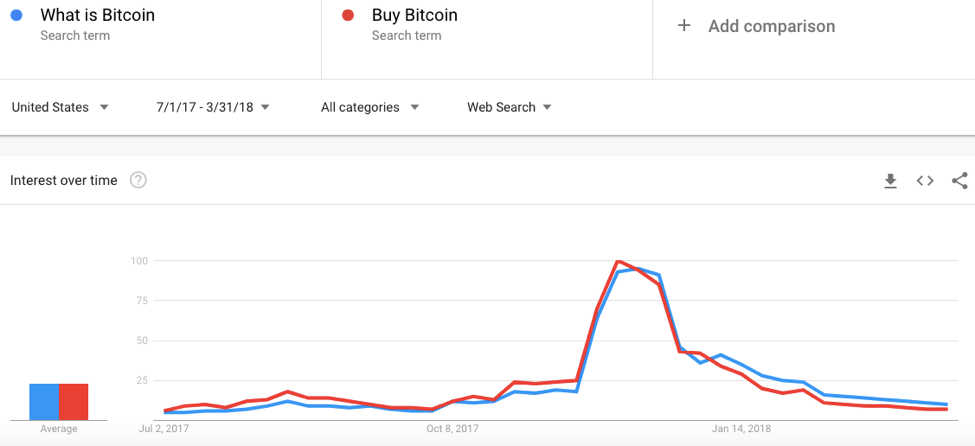
There it is! Why do I think the December 2017 price surge was speculative? Well…other than that the previously described utility valuation method indicated that Bitcoin was overpriced at the time, take a look at the below Google Trends graph I pulled, revealing the number of people searching Google for the answer to the questions “what is Bitcoin?” and “buy Bitcoin?” over the same time period. Look familiar? The eye test can identify a positive correlation, so let’s skip the regression (though I get it – correlation does not always imply causation– but it sure makes sense to me). Do people who buy Apple (AAPL) stock have to “Google it” right before purchasing? I doubt it. Speculation and lack of knowledge led the general public to believe that everyone could simply get rich quick.

trends.png

While Bitcoin (BTC) often experiences large price swings relative to a traditional equity, it’s arguably the most stable digital asset. There are over 1,500 different cryptocurrencies trading on hundreds of different exchanges and only the top 20 digital assets make up ~90% of the total market capitalization! In general, financial markets are most efficient when price discovery is transparent and assets are liquid, so when much of the crypto marketplace remains unregulated, fragile, fragmented, and filled with “dumb money” (not my term), the potential for extreme volatility exists.

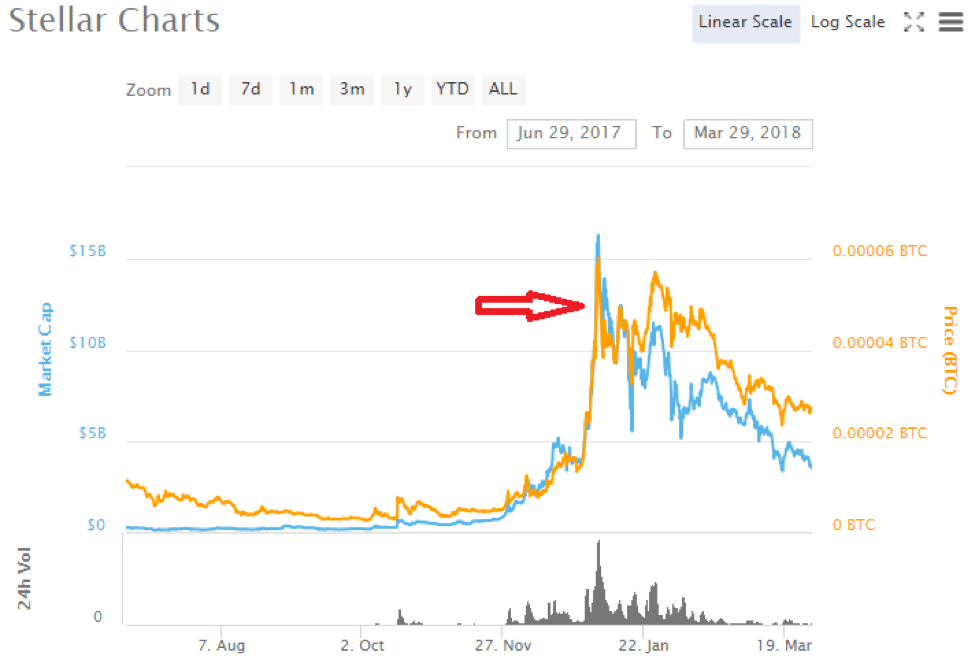
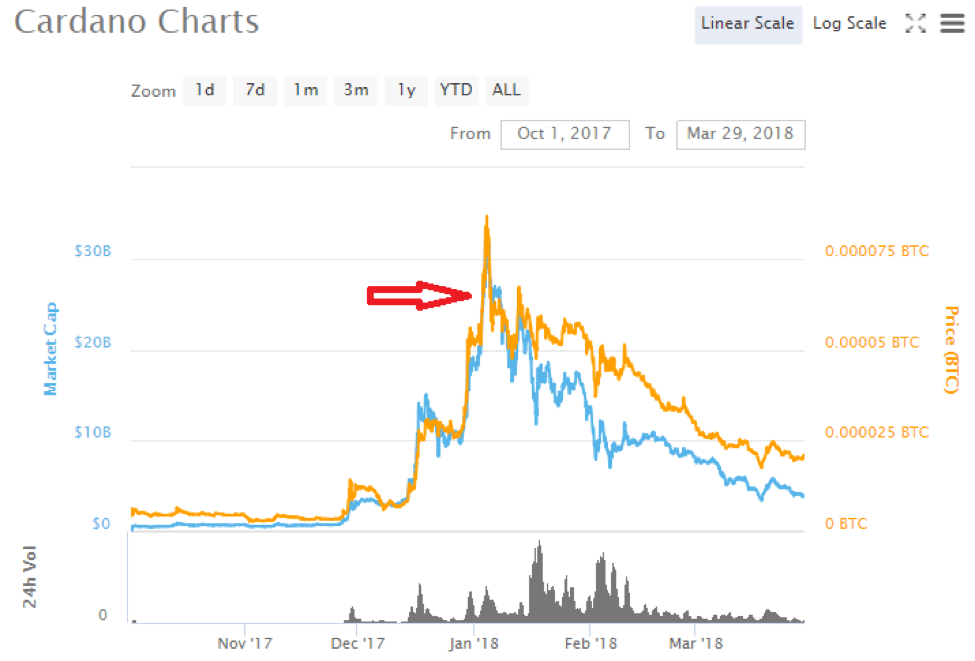
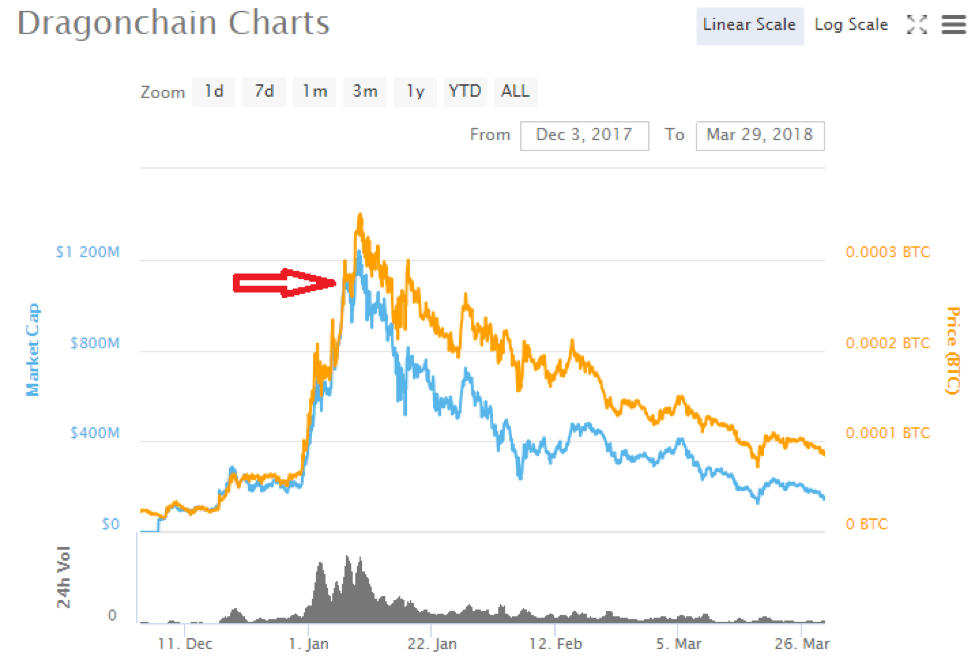
Price movement based on speculation is deceiving, and it drove the prices of less stable assets wild during the December crypto craze. The illogical economics of short-term potential utility value severely outweighed the actual utility value derived from remittances in the network (for currency) or the substitution of a resource that was being provisioned by a crypto network on its blockchain. Examples?

Stellar (XLM)

stellar

TRON (TRX)

tron.png

Cardano (ADA)

cardano.png

Dragonchain (DRGN)

dragon.png … and the list goes on, but you get it. The prices of digital assets the last few months have been more “stable”, but the debate about the value of Bitcoin and other digital assets rages on. I understand critics’ skepticism about Bitcoin as a currency – it’s unstable and its processing time is slow… and even with the creation of the Lighting Network, complications remain. In the long run, Bitcoin is more likely a storage of value (like gold) than an actual currency. What I do believe in is the power of the blockchain and the socio-economic value of a decentralized system that can reduce costs and create transparency for the appropriate applications.
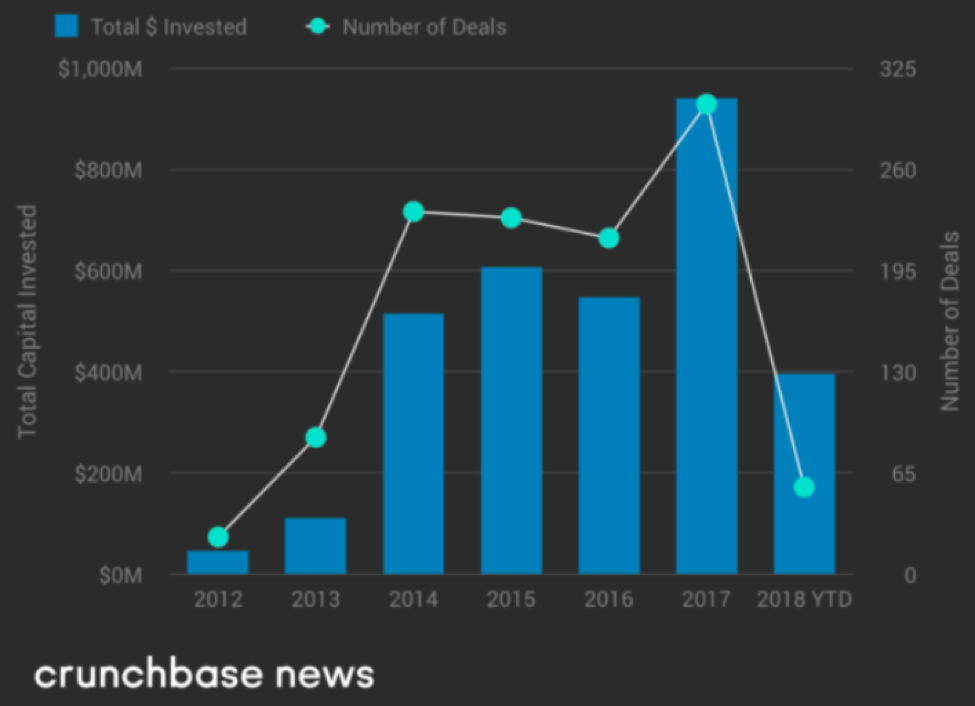
If you don’t agree, that’s perfectly OK, you’re not alone, but many in the venture community stand on my side of the divide. Venture support shouldn’t come as a surprise – it’s in the DNA of venture capital to find and promote disruptive technology, and blockchain technology has the potential to disrupt a wide range of industries, including banking, real estate, healthcare, legal, politics, and education…just to name a few. Without including the increasingly popular Initial Coin Offering (ICO) money, the below graph indicates that venture investments in blockchain-focused startups in just the first two months of 2018 totaled ~40% of the total 2017 capital raised.

venture.png

Whether you’re a believer in blockchain technology and the birth of a new asset class, or believe that this entire movement is just a scam, it is impossible to deny that we are living through an exciting time that challenges the power of a central authority. Right or wrong – opportunities exist, established processes will be tested, and fortunes will be made and lost – and I, for one, can’t wait to see how the intersection of technology, economics, and human psychology comes together.

For a very long time everybody refuses and then almost without pause everyone accepts.
– Gertrude Stein

bob.png

I Think About: 33 vs. 23 and Winging it More Confidently

The realization that I’m more than a decade removed from college is difficult for me to comprehend. Dare I ask: where did the time go? A rhetorical question posed and gone unanswered time and time again. With each year passing by seemingly more quickly than the last, I felt it important to reflect on where I’ve been and how I got here. In many ways, I feel no different than I did ten years ago, despite considerable change in my personal and professional life. As I look back at the many years of experiences and growth, I’m satisfied and can smile when I recognize one simple constant: I’m still really kinda winging it… just… more confidently.

But wait… what does that really mean? To “wing it” is just a stupid English idiom that means to improvise, but where does one draw the line between preparation and improvisation? While I can’t definitively provide the answer, I’m here to say: you can certainly do too much of both. There is no shortage of literature written about various forms of preparation and individual growth techniques, but I can assure you that there is no magic recipe, as there are exceptions to nearly every rule. The fine line between preparation and improvisation lies within the depths of each individual person, and with each opportunity, each lesson learned, we subsequently grow more powerful and confident.

At 23, I operated with a false sense of confidence (some may call it arrogance) that I was well-equipped to do anything I desired, but doubt can quickly set in when reality pays a visit. Winging it then was more or less just a shot in the dark – not from any particular mistake(s) I had made, but simply from the fact that I was young and deprived of living through any practical real-life challenges. In retrospect, I recognize how ill-equipped I really was to tackle anything outside of my comfort zone.

Winging it works best when previous life situations and experiences have prepared you to put your best foot forward. Easy to say now – it sure is funny how clear hindsight can be.

At 33, I believe that confidence develops from always playing the game, being willing to fail (fast), and learning from each experience. While humbling, it helps me to frame it such that no one ever truly fails: you either succeed, or you learn. Over time, this mentality inherently allowed me to nurture my strengths while acknowledging my weaknesses. The perspective is critical, because the world is far too chaotic and random to attempt to prepare for every scenario, and it’s futile to deny such a basic observation.

I challenge anyone reading just as I would challenge myself: find your balance. When you discover the optimal mix of preparation and improvisation, winging it becomes comfortable and natural, and you’re a better teammate and leader as a result. For me, the path to discovery has been a ten-year journey of trial and error, and it’s far from over.

So – what’s the difference between 33 and 23? Well… a lot. I’m a little older and hopefully a little wiser, but truthfully, I’m still really kinda winging it… just… more confidently.

I Think About: Space Exploration, Space Tourism, and Humanity’s Reach for the Stars

Look to history to confirm: human beings are explorers. Curiosity about what lies beyond the horizon is written into countless tales from the past, and the future will be no different. Space has been a lifelong passion of mine, and thanks to innovation and advancements in technology, we are now able to see and understand the cosmos like never before.

One of the most famous photographs ever released by NASA is the Hubble Ultra-Deep Field (HUDF), an image containing more than 10,000 individual galaxies dating back ~13 billion years. Initially, 10,000 may sound like a lot, but to put the vastness of space into perspective, if an individual standing on Earth were to hold up a penny to the sky with an outstretched arm, the 10,000 galaxies in the image would fit within the area of Abe Lincoln’s eye! Yep, space is big. To further blow our minds, Astronomers and Astrophysicists collectively agree that one of the galaxies in the image is so large that based on our current understanding of physics, it technically shouldn’t exist. What does that tell us?! That we still have a lot to learn about the laws of the universe! Two things I know for certain: someday in the future, a brilliant person will reconcile these mysteries of space with the fundamental laws of the universe, and unfortunately, that person will not be me.

With help from SpaceX, NASA will soon launch the Transiting Exoplanet Survey Satellite (TESS) to identify exoplanets orbiting stars in our galactic neighborhood by monitoring temporary dips in a star’s brightness caused by planetary transits. In 2020, Hubble’s successor, the James Webb Space Telescope (JWST), will launch and settle into deep orbit at a distance 4x farther from Earth than the Moon. Its mission purpose, among other things, is to take a more detailed look at identified exoplanets by studying their atmospheric makeup in a search for the known building blocks of life. The JWST is an impressive feat of engineering and is many years in the making. The visual images it is expected to produce should trump anything produced by Hubble in terms of detail and beauty, but that is simply the product of 30 years of technological advancement. That said, even the JWST likely won’t be able to conclusively identify life outside of our solar system simply by studying the atmospheric makeup of exoplanets, and we’ll never be able to physically travel to any leading ‘Earth twin’ candidates without figuring out how to distort spacetime because… yep, space is big. For the foreseeable future, space travel via some form of propulsion is our best option, and everything else remains science fiction. I believe that the first definitive evidence of life outside of Earth will come from identifying a non-natural object in space that was not built by humans.

An appropriate lead-in. Let’s pause for a moment to talk sci-fi in real-life. Last year I backed a Kickstarter project called ‘The most mysterious star in the Galaxy’ to help fund telescope time for Astronomers studying star KIC 8462852 (better known as Tabby’s Star). Tabby’s Star was, and still is, experiencing irregular dips in its brightness indicating that a non-planetary object is transiting the star. The size of previously observed dips (blocking up to 20% of the star’s brightness) led some Astronomers (and wannabe Astronomers such as myself) to believe that a large artificial object – cue the hypothetical Dyson Sphere – was orbiting the star to harness its energy for use by a Kardashev Scale Type II civilization. Recent observations which studied dips in real time suggest the dips are not the same depth at all wavelengths, meaning whatever is blocking the light is not opaque. Experts took this information and ruled out the possibility of an artificial structure, though there is still no consensus on what is actually causing the irregular dips in brightness. I haven’t given up hope that something special is happening around Tabby’s Star, and think it is unreasonable to assume we would have any understanding of technology built by a civilization that could have the resources to construct something to this scale. I’m not saying it’s aliens… but it might be aliens!

OK – back to reality. Closer to home, remarkable companies such as SpaceX, Blue Origin, Orbital Sciences, Virgin Galactic, and the lesser known non-profit organization Space for Humanity plan to offer different types of space tourism opportunities, including orbital, suborbital, and lunar space experiences. The front page of the Space for Humanity website says “Granting the Gift of Perspective.” That statement strongly resonates with me, because I believe that perspective is one of the most important things a person can learn. Perspective has multiple definitions, and while a ride on Space for Humanity’s ‘Worldwide Space Vehicle’ will grant ordinary citizens the unforgettable perspective of both the curvature of our globe and vastness of space, it will do far more than that. Perspective is also an attitude, it’s a point of view, and it’s a deeper understanding of the world around us. A ride into space will be about showing people what is possible, and what the future of space tourism will look like. It is proof of what is to come, and the opportunity to get a first-hand look at how small we are in our little part of the universe.

Space truly is the final frontier, and in the future, it can have the unique ability to unite humanity as one. Regardless of race, gender, nationality, religion, or political affiliation, we are all citizens of the world. As we continue to develop our technology over the coming years and decades, we will become a multi-planet species, and how society reacts to this inevitability depends on what we do now as pioneers for the push into space.

To all my fellow space enthusiasts… Godspeed!

I Think About: The Journey Ahead. Reflections of Post-MBA Released into the Wild

As a recent MBA graduate, I often hear the question “what are you going to do with all that free time?” The short answer is – whatever I want – but the long answer requires a lot more thought. Working full-time, taking evening classes, and attempting to not ignore family and friends for two and a half years left little spare time to explore passion projects or other interests, but that doesn’t mean I didn’t often dream about life on the other side.

I loved my time at Booth. The late nights, the weekends spent whiteboarding for hours on end, and the constant reading and studying were certainly tiring, but the grind contributed to an ongoing feeling of pride and accomplishment. Booth taught me practical skills in finance, strategy, entrepreneurship, and management, but the real value-add to an MBA is what goes on underneath the surface. Graduate school completely changes the way you think, and as a result, I am a different person today than I was the first day I walked through the door in 2015. My desire to learn and grow has never been stronger, and although formal schooling is behind me, education remains a crucial aspect of my life. I owe this renewed intellectual curiosity to the people and program at Chicago Booth, and I am determined not to waste it.

So now I’m left to ponder: what’s next? Change is the law of life, and it is important to embrace the tailwinds. I recognize that the opportunities are truly endless and that the future comes one day at a time. For now, I’m eagerly embarking upon the next chapter, and look forward to what is to come.

And if nothing else… I started a blog.